Top NBA Betting Markets and Odds for UK Punters in 2026
 Available in US
Sharper NBA lines for UK punters — every tip-off
Table of Contents
- NBA Betting in the UK (2026): Current Market Trends and Opportunities
- What this guide gets you to in five bullets
- The UK gambling market behind every NBA line
- Who actually watches and bets on the NBA from the UK
- The core NBA markets: moneyline, spread, totals
- Player props, bet builders and same-game parlays
- In-play betting and the UK late-night problem
- Reading NBA prices in fractional odds
- What separates a serious UK NBA book from the rest
- A pre-bet checklist for every NBA slip
- Integrity, the Rozier-Billups case and what it changed
- What the April 2026 RGD hike means for your odds
- Where UK punters actually discuss NBA bets
- Tools for staying in control: GamStop, limits, the Levy
- Frequently asked questions about NBA betting in the UK
- Betting smarter, not harder: the long view
NBA Betting in the UK (2026): Current Market Trends and Opportunities
Nine seasons of staring at NBA lines from a London desk has taught me one thing — this market behaves nothing like a Saturday football coupon, and British punters who treat it that way usually leak money. The tip-off is at one in the morning. The prices print as 4/6 instead of 1.67. The injury report drops while you are asleep. The operator running your account is licensed by the UK Gambling Commission, not Nevada.
That last bit matters more in 2026 than when I started. Remote Gaming Duty almost doubled on the first of April. The NBA is rolling out a stricter integrity protocol after last autumn’s federal indictments. The league is openly courting London for a 2027 European franchise. None of these forces lives in isolation — they all show up in the price you click.
Important. NBA betting in the UK is legal only with operators holding a current UK Gambling Commission licence. You must be 18 or over. If the spend is getting away from you, the tools to slow it down sit in your account settings — deposit limits, reality checks, time-outs, GamStop self-exclusion.
The NBA is a small slice of UK betting — roughly 3 percent of British gamblers touch it in any given month, against the 6 percent placing live football bets in the same Q1 2025 window. But basketball participation in England has just hit its highest recorded level — 344,400 adults playing at least twice a month — and the audience following the league here skews young, urban and unusually engaged with American sports.
We will walk through the lot — market context, who bets the league, core slips, props and builders, the integrity squeeze, the April tax change, and the places UK punters actually talk about all of this.
What this guide gets you to in five bullets
- The UK gambling market hit £16.8 billion in gross gambling yield for the year ending March 2025, and online betting carries the bulk of that — but the NBA still pulls only around 3 percent of British punters.
- Remote Gaming Duty rises from 21 percent to 40 percent on 1 April 2026, and the cost will land in your prices as wider overrounds on NBA lines.
- The Rozier-Billups federal indictments of October 2025 reset how UK books price player props — fewer markets, tighter limits, faster suspensions.
- NBA tip-offs from London sit between midnight and six in the morning, which forces a real choice between live betting tired and pre-game betting disciplined.
- Reading 4/6, 5/2 and 11/10 fluently is the entry ticket — fractional odds are the UK convention, and every example in this guide is presented that way.
The UK gambling market behind every NBA line
A friend who runs odds for a mid-tier UK book once told me, half-joking, that the NBA team in his trading room is two people and a kettle. Football trading is a department. Horse racing is a department. NBA is a corner. That sentence explains more about UK sportsbook pricing than any market overview — the league is small change inside a big machine.
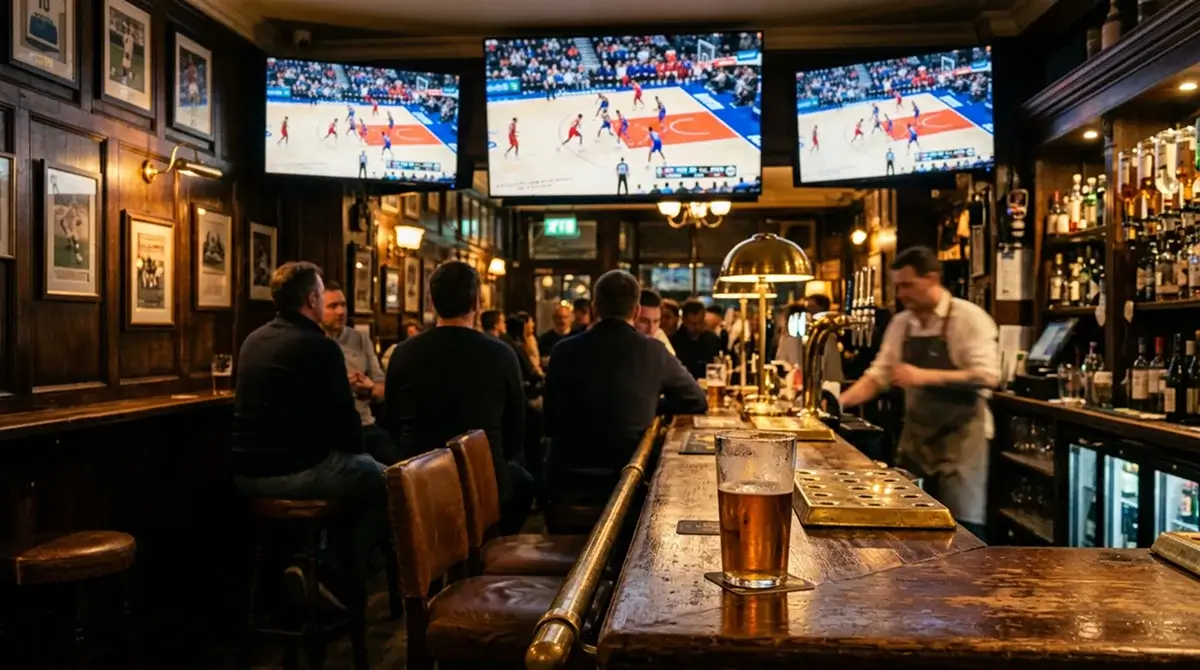
The customer-facing UK gambling industry generated £16.8 billion in gross gambling yield in the year to March 2025, a 7.3 percent jump on the year before. Online took the lion’s share — online GGY rose by more than £900 million to £7.8 billion. The Remote Casino, Betting and Bingo segment now accounts for 46 percent of all British gambling GGY, while land-based has slid to 29 percent at £4.8 billion. Eleven consecutive years of decline have left Great Britain with 5,825 betting shops.
That headline hides a recent wobble. Online GGY in the third quarter of 2025-26 fell 2 percent year-on-year to £1.5 billion, with a sharper 18 percent drop in online real-event betting GGY to £530 million. The same line in Q4 of the previous year had been £596 million and rising. Sportsbook revenue is contracting in real time, and a tax hike has just landed on top.
The active customer base sits at around 13.5 million monthly active online accounts in Q4 2024-25, down to 12.7 million by Q3 2025-26. UK gambling advertising spend runs to roughly £1.5 billion a year, 20 percent of it allocated to safer-gambling messaging.
Why the UKGC frame matters for an NBA punter. A UK Gambling Commission licence separates operators you can legally use from a long tail of grey-market sites that will happily take your money and disappear when a dispute hits. Licensed books must publish account terms in plain English, segregate customer funds, run age and ID verification, and offer mandatory safer-gambling tools. The licence number lives in the footer of every legitimate site.
Grainne Hurst of the Betting and Gaming Council framed the regulatory mood neatly: the industry’s own advertising spend is contracting and shifting toward safer-gambling content, while unlicensed operators outside UKGC’s reach push the other way with no checks.
£16.8B — Total UK gambling GGY for the year ending March 2025, a 7.3 percent year-on-year increase.
£7.8B — Online gambling GGY across the same period, up by more than £900 million.
5,825 — UK betting shops as of March 2025, the eleventh straight year of decline.
Three numbers worth holding in your head. They explain why the UK NBA market looks the way it does — big enough that mainstream books carry it, small enough that pricing is occasionally lazy, embedded in a regulatory regime getting more expensive to operate inside by the quarter.
Who actually watches and bets on the NBA from the UK
I once asked a Camden pub landlord why he kept the NBA on the screens at one in the morning when half the place was empty. His answer stuck — “the lads who stay are the ones spending.” That is the UK NBA audience in a sentence. Not large, but loyal, young, and betting at a level that punches above its share.
The official numbers back the anecdote. In a six-market international study covering the US, UK, Germany, France, Italy and China, just 7 percent of UK internet adults reported watching the NBA — the lowest share. But 77 percent of British people who identify as basketball fans say they watch NBA games. Penetration is shallow. Conversion of fan to viewer, once you cross the basketball threshold, is enormous.
The age distribution is the part that should interest anyone trading NBA prices here. 57 percent of UK NBA viewers are aged 18 to 34 — the highest share among the six surveyed markets. That is the most mobile-first, most parlay-curious, most prop-fluent demographic in British sports betting. Cross-engagement is also unusually strong: 42 percent of UK NBA fans watch at least one other American professional sport.
Did you know? Adult basketball participation in England hit 344,400 people aged 16 and over playing at least twice a month in the year to November 2023 — the highest level since the Active Lives Adult Survey began in 2015-16. Add the children’s data: nearly 1.2 million UK kids aged 5 to 16 play basketball weekly, making it England’s second most popular team sport after football.
The supply side is catching up. TNT Sports broadcasts at least 250 live NBA games per UK season, with at least nine matches each week. NBA League Pass UK ran at £109.99 for the full 2024-25 season or £16.99 monthly.
57% — Share of UK NBA viewers aged 18 to 34, the youngest profile across six surveyed markets.
You are betting into a market dominated by mobile-native twenty-somethings who jump comfortably between an NBA prop, an NFL spread and an MLB futures price. Books know this. Their interfaces, welcome promotions and bet-builder pushes are all calibrated for that user.
The core NBA markets: moneyline, spread, totals
My first NBA bet was a four-team accumulator picked on team logos I liked. It lost, naturally. The useful lesson came two weeks later when a senior trader spent forty minutes explaining what the three numbers next to a basketball fixture actually represent. Until you understand the moneyline, the spread and the total — and how the juice is buried inside all three — you are not betting on the NBA. You are guessing.
Three core markets carry roughly four-fifths of NBA volume on UK books. Get fluent in these and most of the league becomes legible.
Moneyline — a straight bet on which team wins, no points adjustment. Shown as fractional odds in the UK. The favourite carries shorter odds, the underdog longer.
Spread — a points handicap that levels the contest. The favourite “gives” points to the underdog. You bet whether your team covers, not whether it wins. Sometimes called the line, the pointspread or ATS.
Totals — also written as O/U or over/under. The book sets a combined points line for both teams. NBA totals typically sit between 215 and 240 in the modern era.
Juice — the operator’s margin baked into the price, also called vig or overround. On a 50-50 market, books shorten the fair evens to roughly 10/11 each way — the gap is the juice.
The moneyline is the simplest market and often the trap for new UK punters. Big NBA favourites get expensive fast. A textbook example surfaced during the 2026 playoffs. In Game 2 of a Wolves-Spurs series, the public piled onto San Antonio at -450 American — roughly 2/9. 67.7 percent of moneyline tickets backed the Spurs. Yet 64.8 percent of total handle was on Minnesota at +350, or about 7/2.
The lesson generalises: heavy chalk on the moneyline gives almost nothing for being right and ruins you when you are wrong. Most experienced UK NBA punters live on the spread instead, which prices both sides at roughly 5/6 each way once the juice is in.
Why NBA spreads matter more than moneylines. A four-point spread on a -180 favourite turns a 64 percent moneyline implied probability into something close to 50-50 against the line. Smaller edges, more workable maths.
Totals deserve their own paragraph because the NBA has changed underneath them. Two decades ago, an over/under of 195 was normal. Today’s NBA averages closer to 230 combined points — pace, three-point volume, foul-rate and rest disparities all push the line. A 240 total in a high-pace matchup with two thin benches is not the same proposition as 240 in a half-court grind between top-five defences.
Worked moneyline example. Stake £20 at 11/8 on a moderate underdog. Returns if it wins: £20 × (11/8) = £27.50 profit, plus stake = £47.50 back. Implied probability of 11/8 is roughly 42.1 percent. If your read says the underdog wins more than 42 percent of the time, the bet has positive expected value.
For a deeper map of when a totals bet beats a spread bet on the same fixture, how to convert between fractional and decimal odds without a calculator, and when teaser markets deserve a slot, see our deep dive into NBA betting markets for UK punters.
Player props, bet builders and same-game parlays
Props are where most British punters either fall in love with the NBA or get quietly punished by it. A friend in the Northern Quarter texted me last spring with a six-leg bet builder at 18/1, a tenner staked. He had not noticed two of his legs were strongly correlated and the book had priced that in. He lost. Of course he lost.
Prop bet — short for proposition bet. A wager on a specific event inside a game that is not directly the final result. NBA props typically cover individual player stats: points, rebounds, assists, threes made, turnovers, steals, blocks, double-doubles, triple-doubles.
Parlay (accumulator, multi) — multiple selections combined into one slip. All legs must win. A four-leg parlay where each leg is 50-50 has an actual win probability around 6 percent, not 25.
The 2025-26 NBA season fielded a record of more than 130 international players, which has done more for the British prop market than any single piece of marketing. UK punters increasingly recognise names from the Eurobasket circuit — they bet on Luka Dončić scoring lines and Nikola Jokić triple-double odds the way previous generations bet on Premier League first goalscorers.
Bet builders and same-game parlays are the marketing engine of the modern UK sportsbook. The pitch is seductive — combine a moneyline, a spread, a player points over and a double-double leg into one slip and watch the price balloon to 25/1 or beyond. The reality is sober. Books price these aggressively because the typical builder slip is full of correlated legs and over-confident reads of star usage rates.
Mike Barner of the SportsLine prop desk framed the analytical edge well this spring on a Karl-Anthony Towns matchup — Towns had averaged six assists per game against the Hawks in the first round, while his over/under for total assists in the next series was set at three and a half. Six against three and a half is a substantial gap. That is the kind of read that survives the math.
Worked example: a sensible single prop versus a stacked builder.
A star player has averaged 28 points per game over his last eight starts. The book posts his points line at 26.5, with the over priced at 5/6.
Single prop, £15 stake on the over at 5/6: returns £12.50 profit, total £27.50 back if it lands. Implied probability around 54.5 percent. Your data suggests roughly 60 percent. Modest positive expected value.
The same player included in a five-leg same-game parlay with four other correlated selections at combined 12/1 looks bigger but is statistically punishing.
The structural problem with same-game parlays is not that they cannot win. The price routinely fails to compensate you for the correlation. NBA stat lines for star players cluster: when LeBron James scores 35, he typically also gets six assists. Books used to misprice this. No longer.
I am not anti-builder. I use them maybe twice a week, with two or three uncorrelated legs — a moneyline on one game combined with a points prop on a player in a completely different fixture.
The deeper methodology — leg selection, sample-size requirements, how to spot a tightened prop line, when to fade boost promotions — sits in our full strategy guide for NBA player props in the UK. Props are the highest-value pocket of the NBA market for an analytical punter, and the fastest way to bleed your bankroll if you treat them as lottery tickets.
In-play betting and the UK late-night problem
The TNT Sports schedule for a typical Tuesday in February lists a tip-off at 00:30 UK time, sometimes 01:00, occasionally 02:00 if the game is on the West Coast. By the buzzer, four in the morning. This is the single most underestimated structural problem facing UK NBA bettors.

TNT Sports broadcasts at least nine NBA matches per week and 250 across the full UK season. NBA League Pass UK fills the rest at £109.99 for the season or £16.99 a month. The supply of games is not the problem. The wall clock is.
The honest version. Live betting after midnight, while exhausted, with a bookmaker app one tap away, is one of the most reliably loss-generating routines in UK sports betting. Set deposit limits before the season starts, not at three in the morning when you are chasing a quarter you should not have stayed up for.
Live betting — also called in-play — is genuinely interesting on the NBA because the sport is so volatile. A 10-point lead in the first quarter is meaningless. A 10-point lead in the fourth, with five minutes left and the favourite in foul trouble, is meaningful. Books update spread, moneyline and totals continuously. Sharp money is in the market in real time.
What “live betting” means on a UK book. The standard menu during an NBA game includes live spread, live moneyline, live totals, live quarter and half lines, and a rotating set of player props. Refresh rates are fast — every few seconds — and bets suspend automatically during free throws, substitutions and reviews. Cash-out values almost always include a hidden margin against the punter.
The opportunity is real. It is also expensive to access. Late-night live betting attracts a tax most British punters never quantify — fatigue, looser stake discipline, the dopamine of a fast-moving market. I keep a strict rule: after 02:30 UK time I watch but do not bet.
Practical adjustments. Pre-game your action — most slips should be locked in before tip-off, on prices you reviewed when rested. Treat live betting as opportunistic, not scheduled. If you are watching League Pass for late West Coast games, use the device’s screen-time limit on your sportsbook app.
Reading NBA prices in fractional odds
The first time an American friend looked over my shoulder at a UK NBA slip, he asked what 4/6 meant. I told him it was a Lakers favourite priced at roughly minus-150 in his money, or 1.67 in decimal. He had a point. Fractional odds are not, on any objective measure, the easiest format. They are the British convention, and reading them quickly is the entry ticket to UK NBA betting.
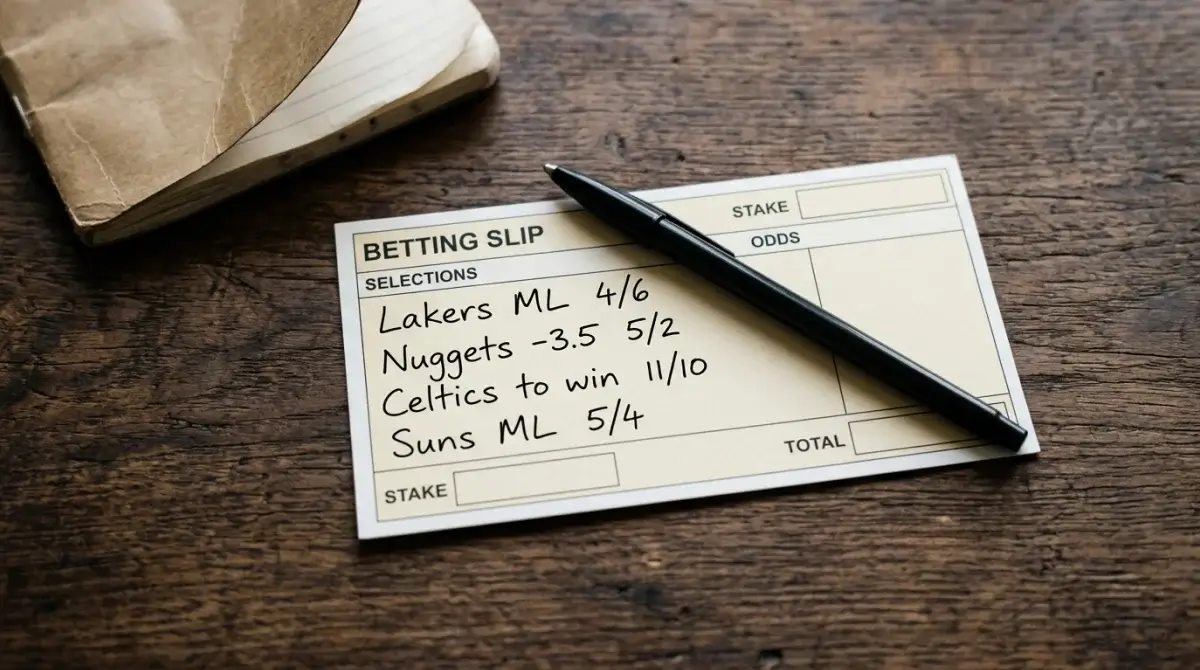
Here is the mechanic in one sentence. Fractional odds tell you, for every unit on the right of the slash you stake, how many units of profit you win on the left. So 5/2 means stake two, win five — total return seven if it lands. 4/6 means stake six, win four — total return ten.
Worked example: a moderate favourite.
Stake £20 at 4/6 on an NBA team you fancy on the moneyline. Profit if it wins: £20 × (4/6) = £13.33. Total return: £33.33. Implied probability of 4/6 is 6 ÷ (4 + 6) = 60 percent. If your read is closer to 65 percent, you have a positive expected value bet.
Worked example: an even-money spread.
Stake £25 at 5/6 on an NBA team to cover a four-point spread. Profit: £25 × (5/6) = £20.83. Total return: £45.83. Implied probability of 5/6 is 6 ÷ (5 + 6) = 54.5 percent. The 4.5 percent gap between 50 and 54.5 is the operator’s juice.
Worked example: a longer-odds prop.
Stake £10 at 11/4 on a player to record a triple-double. Profit: £10 × (11/4) = £27.50. Total return: £37.50. Implied probability of 11/4 is 4 ÷ (11 + 4) = roughly 26.7 percent. Triple-doubles are rare; 11/4 is in the ballpark of fair for a player who has had two or three already in the recent stretch.
Quick conversions worth memorising. Evens (1/1) is decimal 2.00 and 50 percent implied. 5/6 is decimal 1.83 and 54.5 percent. 4/6 is 1.67 and 60 percent. 11/10 is 2.10 and 47.6 percent. 6/4 is 2.50 and 40 percent. 5/2 is 3.50 and 28.6 percent. Once these become reflexive, you can read a UK NBA card in about thirty seconds.
This matters because almost all of the published NBA betting analysis online is in American odds. To use any of it with a UK book, you need to convert in your head. Decimal is the international compromise — multiply stake by the decimal price for total return including stake. Most UK books let you toggle between fractional and decimal in account settings.
What separates a serious UK NBA book from the rest
British punters often ask which bookmaker is “best for the NBA.” It is the wrong question. Best for what — the menu, the prices, the in-play interface, the speed of withdrawal? No single UK book is best at all of those, and punters with the longest careers in this market routinely hold accounts at three or four operators and shop the line.
The data hints at the rough order of UK preference. Among Premier League fans who gamble, Sky Bet leads with 26 percent weekly usage, followed by Bet365 at 17 percent and Paddy Power at 12 percent. NBA-betting brands tend to inherit those patterns.
Rather than rank operators — that belongs in our dedicated review of UK NBA betting sites — here are the criteria I apply when deciding whether a book deserves a slot in my rotation.
| Criterion | What to check | Why it matters for NBA |
|---|---|---|
| UKGC licence | Valid number visible in footer | Non-negotiable. No licence, no account, no exceptions. |
| Market depth | Pre-game props per game; live menu breadth | Thin menus mean you cannot execute the bet you want at the price you want. |
| Overround | Sum of implied probabilities on a 50-50 spread | The lower the overround, the better your long-term expected value. |
| Settlement speed | Time from buzzer to credited stake | Slow settlement on late-night NBA delays your next opportunity. |
| Withdrawal terms | Limits, processing time, ID checks | Books that pay slowly prefer you keep funds in the account. |
| Customer terms | Stake-cap policies, account restriction history | Some books restrict winning accounts aggressively. Read the forums. |
Two rows deserve elaboration. Overround is the single most important number for a long-term NBA bettor and almost no UK punter checks it. Add the implied probabilities of both sides of a market — a perfectly fair market totals 100; UK NBA spreads typically total 109 to 112. The lower the number, the cheaper the book. Two points over a 100-bet season is real money.
Customer terms matter too. A subset of UK books will quietly cap the stakes of customers they perceive as winning. No UKGC rule prohibits it. Your only protection is reading recent forum discussion before funding an account.
Do
- Hold accounts at three to four UK-licensed books, and price-shop every meaningful slip.
- Verify the UKGC licence number in the footer before depositing.
- Set deposit and time-out limits before your first bet of the season.
- Test withdrawal speed with a small amount before trusting the operator with a real bankroll.
Don’t
- Choose a book on welcome offer alone — the offer is short-term, price quality is permanent.
- Use any operator without a visible UKGC licence.
- Deposit using a credit card — UKGC rules have prohibited this since April 2020.
- Stack promotional bonuses without reading the wagering requirements.
A pre-bet checklist for every NBA slip
I keep a printed checklist tacked to the wall above my desk. It is unglamorous, short, and after nine seasons of NBA betting it is the single most useful tool I have. Every slip I post goes through it. Slips that fail any check do not get posted.
Most losing NBA bets are not bad reads — they are good reads taken at the wrong price, on stale information, with too much stake. A checklist is a forcing function that catches the mistakes you make tired, distracted or chasing losses.
The eight-point checklist before any NBA slip
- Did I check the official NBA injury report? Status changes drop on a fixed clock; ignoring them is voluntary blindness.
- Have I confirmed the starting lineup, not just the active list? A questionable player who starts is a different matchup from one coming off the bench.
- Is this price the best available across the books I hold accounts with? If I have not line-shopped, I am paying a tax I did not have to pay.
- What is the implied probability, and is my read on the matchup actually higher than that number?
- Is the stake sized as a fraction of my pre-defined bankroll? Flat-stake or fractional Kelly. Never “what feels right tonight.”
- Have I checked schedule context? Back-to-backs, three-in-four nights, cross-country travel, rest disparities.
- Have I avoided correlation in any parlay or bet builder? If two legs depend on the same outcome, the price is not what it looks like.
- Am I betting because I genuinely have an edge, or because there is a game on and I want action? Honest answer required.
Larry Hartstein of the SportsLine NBA column captures the approach well. Watching Detroit grind out a Game 7 this spring, he focused on Ausar Thompson’s heavy minutes — 36 and 37 in the prior two games — and framed his projection as a defensive grinder with elevated rebound and missed-shot numbers. The bet there is not “Pistons win.” It is missed shots and rebounds inflated by elevated minutes for a specific player.
The same SportsLine projection model entered the second round of the 2026 NBA Playoffs at 26-9, or 74 percent, on its top-rated NBA spread picks. That is what data-led, situationally-aware modelling produces when paired with disciplined execution. Most of us will not build that model. We can copy the discipline.
For the deeper architecture — bankroll sizing, unit definition, when to fade public consensus, how to read closing line value — see the NBA betting strategy guide for UK punters.
Integrity, the Rozier-Billups case and what it changed
October 2025 is the month most UK NBA bettors will look back on as the moment the prop market changed shape. Federal indictments unsealed in the Eastern District of New York charged Miami Heat guard Terry Rozier and Portland Trail Blazers head coach Chauncey Billups in what investigators described as an insider sports betting conspiracy. It was the largest NBA betting-integrity case since the Tim Donaghy referee scandal nearly two decades earlier.

The case landed during pre-season. By the time the regular schedule tipped off, every UK book carrying NBA player props had quietly pulled markets, tightened limits or both. No announcement. The menu just got shorter.
Adam Silver, the NBA Commissioner, addressed the case on NBA on Prime in October. He said there was nothing more important than the integrity of the competition, that he had a pit in his stomach, and the situation was very upsetting. Two months later, at the NBA Cup final, he sharpened it — if the game is not viewed as honest, the league will lose its fan base over time.
US Attorney Joseph Nocella Jr. described the case as an insider sports betting conspiracy that exploited confidential information about NBA athletes and teams. The integrity vulnerability prop markets create is asymmetric: someone close to a player or coach knows whether the player is healthy, motivated and minutes-restricted; the rest of us are guessing.
What the indictments mean for your slip in 2026. UK-licensed books have responded by reducing prop market depth, lowering single-player stake caps, and accelerating bet suspensions when unusual money hits a specific prop. You will see fewer obscure props on the menu and lower limits on those that remain. The mainstream prop market — points, total rebounds, assists for starters and key rotation pieces — is still active, just on tighter terms.
Sports betting on NBA outcomes is now legal in roughly 40 US jurisdictions and approximately 80 countries, expanding what Silver has called the league’s global integrity surface. Every additional jurisdiction is another set of monitoring obligations.
Silver framed the league’s internal review as a redoubling of effort across rules, education and injury reporting. Both have direct consequences for prop pricing: better-trained players means fewer incidents; cleaner injury reports mean tighter lines.
For the full integrity story — what the league’s prop-bet protocol looks like, which sub-markets disappeared from UK menus, how to read the new regime — see our deep dive on NBA integrity and the future of prop betting in the UK.
Integrity reshaped the menu. The next structural shift is reshaping the price.
What the April 2026 RGD hike means for your odds
If you opened a UK sportsbook account in 2024 and the same account in May 2026, prices on NBA spreads have quietly drifted. Marginally wider overrounds. Slightly worse moneyline juice. It is the operator absorbing — and beginning to pass on — the largest tax shock to hit British online betting in a generation.
Remote Gaming Duty, the levy on UK-licensed online operators’ gross gaming yield, rose from 21 percent to 40 percent on 1 April 2026. That is a near-doubling of the cost base for every regulated online sportsbook in Britain. Industry analysts project around 800 UK casino and betting operators will close by 2027 as a knock-on combined with broader regulatory tightening.
The arithmetic from the punter’s seat is straightforward. Operators have three levers when their tax bill doubles: cut costs, increase margin, or accept lower profit. The first lever has limited room — UK gambling already spends roughly £1.5 billion on advertising annually and that line is contracting. The third conflicts with shareholder expectations. The middle is the path of least resistance.
What “wider overround” looks like in practice. Take a 50-50 NBA spread. In 2024, a typical UK book might price both sides at 5/6, total implied probability of 109 — a 9 percent margin. Post-April 2026, that same market may post at 10/11 each side or even 8/9, lifting the total to 110 or 112. Two extra points of overround across an NBA season is the difference between a slim profit and a slim loss for a recreational punter turning over £100 a week.
The change does not hit every market equally. Operators tend to protect headline prices on high-volume football and absorb more of the impact on smaller sports — including the NBA. The volume is low enough that operators do not feel commercial pressure to keep prices keen, and the punter base is loyal enough that demand will not collapse if prices tighten.
21% → 40% — Remote Gaming Duty almost doubled in the UK on 1 April 2026, with the cost increasingly priced into NBA betting margins.
The punter’s strategic response is not complicated. Line-shopping matters more than ever — if the average UK NBA spread now sits at 110 to 112 overround, finding books still pricing 109 is worth real money. Promotional offers deserve more scrutiny — they are increasingly used to disguise tighter base prices. And the volume of bets you place should probably go down, not up.
Where UK punters actually discuss NBA bets
Where do British NBA punters actually talk to each other? The answer matters more than people think — the quality of your information network is one of the underrated factors in long-term performance. You can have the best model in the world, but if you read the same takes everyone else is reading, your edge is not edge.

UK NBA discussion is fragmented across three quite different ecosystems. None is dominant. Most experienced punters lurk on at least two.
| Space | Register | Strengths | Weaknesses |
|---|---|---|---|
| Long-form forums | Detailed, threaded, slow | Genuine analysis, archive value, posters with track records | Skews older, US-heavy, UK voices in the minority |
| Reddit communities | Conversational, fast, image-heavy | Massive volume of takes, useful for sentiment-checking the public side | Noise-to-signal ratio is brutal; “hammer this” posts dwarf actual analysis |
| Discord servers | Live chat, real-time, often paid | Speed during games, smaller communities of serious punters | Quality varies wildly; tipster servers are mostly extraction operations |
Forums are the closest thing UK NBA betting has to institutional memory. Threads from years past still surface useful patterns on how lines moved — elimination games, back-to-back fatigue, post-trade-deadline volatility. The downside is demographic: most long-form NBA forums skew US-based, which means the most active windows are often the British dead of night.
Reddit is the high-volume option. Major NBA betting subreddits run thousands of posts a week during the regular season. Signal density is low — every other post is a nine-leg parlay screenshot — but aggregate sentiment is useful. When 80 percent of posts pile onto the same favourite, that is information about where the public money is heading.
Discord is where serious British NBA discussion increasingly lives, and also where the most extraction operations are. Good servers are small, invite-only or referral-based, structured around specific disciplines — projection models, line-movement tracking, prop analytics. Bad ones are tipster mills charging £50 a month for picks that underperform a coin flip.
One principle holds across all three: public sentiment is not your edge. Reading what 10,000 other punters think of a Lakers spread gives you no analytical advantage — at best it tells you which side the line is being pushed away from. The community that helps is the small one with three or four sharp posters whose track record you can verify.
Tools for staying in control: GamStop, limits, the Levy
I have lost count of the British NBA punters I have watched ride a positive run for three months and then give the lot back in a single late-night session — usually during the playoffs, usually because they convinced themselves they “knew” something. The data is uncomfortable. The Gambling Commission’s Gambling Survey of Great Britain 2024 puts problem gambling at 2.7 percent of UK adults, at-risk gambling at 3.1 percent, and low-risk vulnerabilities at a further 8.8 percent — roughly one in seven adults with some structural vulnerability.
For context, 6 percent of UK adults placed bets on live football in Q1 2025 — the largest single-sport category — against the NBA’s roughly 3 percent share. The NBA bettor base is smaller and skews younger and more mobile, which historically maps to higher risk profiles for impulse-driven patterns.
The toolkit is genuinely good and almost completely underused. UKGC-licensed operators are required to offer deposit limits, time-outs, reality checks, and integration with GamStop. As of April 2025, NHS England assumed full control of the statutory Gambling Harms Levy, centralising treatment, prevention and research funding for the first time. The infrastructure is there. The decision is yours.
If betting is causing you harm. GamStop self-exclusion blocks all UK-licensed operators for a chosen period — six months, one year, five years. It is free, it is binding, and you can activate it in the next ten minutes. The National Gambling Helpline is available around the clock. NHS Gambling Clinics provide free treatment. You do not need to wait until things are bad to use any of these. Setting a deposit limit before you need one is the smartest single thing a punter can do.
Do
- Set deposit and time-out limits before your first NBA bet of the season, not after a bad week.
- Track your wagering on a spreadsheet — to confront the actual numbers honestly.
- Use GamStop self-exclusion as a circuit breaker if you find yourself chasing.
- Treat losing weeks as data, not a personal failing — and do not increase stakes to “win it back.”
Don’t
- Bet money allocated to rent, food, or anything with a fixed bill at the end of the month.
- Bet drunk or after midnight without pre-defining exactly which markets you will touch.
- Believe the “next bet wins it back” voice — that is the voice that built the entire industry.
- Borrow to bet, ever, however good the slip looks.
The simplest single piece of self-protection a UK NBA punter can adopt is to refuse to use any operator without a visible UKGC licence number — every safer-gambling tool above exists because the licence framework requires it.
Frequently asked questions about NBA betting in the UK
Is NBA betting legal in the UK in 2026?
Yes, provided you bet through an operator holding a current UK Gambling Commission licence and you are aged 18 or over. The licence number must be visible in the operator’s footer. UKGC-licensed books must publish account terms in plain English, segregate customer funds, run age and identity verification, and offer mandatory safer-gambling tools. The legal status has not changed in 2026; what has changed is the cost base for operators, which is feeding through into wider overrounds.
What time do NBA games start for UK viewers, and how does that affect betting?
UK tip-offs typically fall between midnight and six in the morning, with most regular-season fixtures landing between 00:30 and 03:00 London time. West Coast games extend the window to 04:00 and beyond. Live in-play betting after midnight, while tired, is one of the most reliably loss-generating routines in UK sports betting. Pre-game your action where possible. Set deposit limits before the season.
Why are NBA odds shown as fractions on UK sites?
Fractional odds are the British convention across all sports. They show how many units of profit you win for every unit you stake on the right of the slash. So 5/2 means stake two, win five. The implied probability of any fractional price is the right number divided by the sum of both — 5/6 implies 6 ÷ 11, or 54.5 percent. Most UK books let you toggle to decimal in account settings.
How does the NBA’s response to the 2025 integrity case shape UK punters’ day-to-day betting routine?
The federal indictments of Terry Rozier and Chauncey Billups in October 2025 triggered a structural shift in how UK-licensed books handle NBA player props. The day-to-day effect is fewer prop markets per game, lower stake limits on what remains, and faster automatic suspensions when unusual money hits. The mainstream menu — points, rebounds, assists for starters and key rotation pieces — is still active. Obscure single-player props on bench pieces have largely disappeared.
Will UK NBA odds visibly change for punters because of the April 2026 RGD hike?
Yes, gradually and unevenly. Remote Gaming Duty rose from 21 percent to 40 percent on 1 April 2026 — a near-doubling of the cost base for UK-licensed online sportsbooks. Operators have three responses: cut costs, increase margin, or accept lower profit. Margin is the easiest lever, which means slightly wider overrounds across NBA spreads, moneylines and totals. The shift is most pronounced on smaller-volume sports like the NBA.
Where can I watch NBA in the UK while I bet?
TNT Sports holds the UK NBA broadcast rights and shows at least 250 live games per season, with at least nine matches each week. The remaining games sit behind NBA League Pass UK, priced for 2024-25 at £109.99 for the full season or £16.99 per month. League Pass also carries the NBA Cup. Most UK sportsbook apps run live in-play betting alongside the broadcast feed.
Betting smarter, not harder: the long view
I started this guide with a confession about my first NBA bet — a four-team accumulator picked on logos, doomed before the first tip-off. Nine seasons later, the difference between the punter I was then and the punter I am now is not a model, not a magic formula and not a particular bookmaker. It is a checklist, a habit of line-shopping, and the discipline to walk away from the screen at 02:30 even when the West Coast game is going to overtime.
The British NBA market in 2026 sits at an unusual crossroads. The audience is small but young and structurally engaged. The regulator is tightening its grip, the integrity floor is higher than it has ever been, and the tax regime that made operators comfortable for a decade has been upended in April. The basketball itself has never been more globally rich — record international rosters, a 76-billion-dollar US media deal, a London-shaped European franchise on the 2027 horizon, and 344,400 British adults playing the game at least twice a month.
The market rewards patience, line-shopping, situational awareness and small repeated edges over large samples. It punishes — reliably, mathematically — the punter who treats it as entertainment with a betting overlay. The choice between those postures is made before you ever load the app.
If you take three things away from this guide, take these: read the price, not the team. Bet the gap between your read and the implied probability. And use the safer-gambling tools sitting in your account settings before you have any reason to need them.
Created by the ”nba Betting Discussion” editorial team.